Tree removal is one of those jobs that looks simple from the sidewalk and becomes complicated the moment a rope, chainsaw, and property lines get involved. In Streetsboro, the mix of older maples, ornamental plantings from the 1970s housing boom, and younger, fast growing species creates a wide range of situations, from routine removals to genuine emergencies.
I have walked more than one property with a homeowner who was sure a tree had to come down, only to find that good tree trimming would solve the problem. I have also had the opposite happen: a tree that “looked fine yesterday” turned out to be a genuine hazard that needed to be removed before the next storm rolled through.
The goal here is to help you tell the difference, make better decisions, and know what to expect if you need professional tree service in Streetsboro.
How Streetsboro’s conditions shape tree problems
Local conditions matter a lot when you are evaluating trees. Streetsboro sits in a zone with cold, sometimes harsh winters, wet springs, and stormy summers. That combination affects both tree health and tree risk.
Many of the issues I see on Streetsboro properties come from three sources: soil saturation, wind exposure, and age.
The soils around the area often hold water. After a week of solid spring rain, the ground under a large maple or oak can soften enough that root plates shift. Sometimes you see a telltale heaving of soil on one side of the tree, or cracks in the ground near the base. That is a serious warning sign. A tall, top heavy tree on soft soil can uproot without much notice, especially under wind.
Wind exposure is another factor. Open lots near fields or commercial areas tend to take stronger gusts than homes tucked into older neighborhoods with many sheltering trees. One large, isolated tree near a corner lot or open field experiences different stresses than a tree in a dense stand.
Finally, age plays into this. Streetsboro saw a lot of residential building over a few key time periods. In many subdivisions, the “big” front yard maple or spruce went in roughly when the house did. So if you know your house is 40 or 50 years old, chances are the original trees are in that same age range, which is mature for many species. Older trees are not automatically unsafe, but they need closer inspection and more regular tree service and tree trimming to remain stable.
When tree removal is truly necessary
Not every problem tree needs removal. Often, targeted pruning, cabling, or soil improvements can buy decades of safe life for a mature tree. That said, there are recurring situations around Streetsboro where tree removal is usually the responsible call.
Severe structural defects are at the top of that list. If the main trunk has a large vertical crack, or if two big stems meet in a tight V with visible separation, you are looking at a failure risk. I once inspected a split silver maple on a corner lot that looked stable from the road. Up close, there was daylight through the union about ten feet above the ground. One more ice storm could easily have sent half of it straight into the street.
Extensive decay is another strong indicator. A little surface rot on a pruning wound is one thing, but when decay affects a large portion of the trunk diameter or major roots, that tree cannot safely support its own weight. You may see mushrooms residential tree trimming Streetsboro at the base, soft or hollow sounding wood when tapped, or chunks of missing bark that expose crumbly interior.
Leaning trees need a bit of nuance. A lean that has been present for years, with good root flare and no soil movement, may be fine. A recent or increasing lean, especially after a storm, is much more worrying. If you stand back and notice that the lean is worse than it was last season, have it assessed quickly.
There are also cases where a tree is perfectly healthy but simply planted wrong for its location. A huge spruce ten feet from a foundation or a mature oak encroaching on power lines can become unmanageable. In those situations, early removal and replacement with a more suitable species is better than waiting until the tree is both enormous and hazardous.
Finally, you have the storm damaged trees. Streetsboro storms often create partial failures, where one or two large limbs break out and leave open wounds. Sometimes careful pruning can restore balance. Other times, especially when the main trunk is compromised, the safest solution is full tree removal.
A quick hazard checklist for Streetsboro yards
Here is a simple field checklist you can walk through on your own property before calling for professional tree removal in Streetsboro:
- Visible mushrooms, conks, or fungal growth around the base or on the trunk Soil lifting, cracking, or mounding on one side of the tree after heavy rain or wind Large dead limbs in the upper canopy, especially over driveways, roofs, or neighbor’s yards Noticeable lean that seems new, worsening, or aimed toward a target you care about Bark falling off in large sheets, exposing soft or hollow wood underneath
If you see one of these in isolation, it is worth monitoring and possibly scheduling a non‑urgent inspection. If you see several on the same tree, especially on a mature maple, oak, ash, pine, or spruce, it is time to get a qualified tree service to take a look.
Tree trimming versus tree removal
Many homeowners call a tree service asking for removal when the real issue is that the tree has never been properly trimmed. Street trees in particular get “lion tailed” by untrained crews, where all the inner branches are stripped and everything is left at the ends. That increases sway and makes the tree more vulnerable in storms.
Good tree trimming focuses on structure, weight distribution, and clearance. On a Streetsboro residential lot, that often means:
You remove crossing or rubbing branches, clean out deadwood, lighten overly heavy limbs, and create proper clearance from roofs, gutters, and service lines. Done right, this can reduce hazards and improve tree health without losing the shade and visual appeal the tree provides.
Tree removal becomes the right choice when trimming cannot correct the underlying risk. No amount of pruning will fix advanced root rot or a deeply cracked main stem. A responsible tree service in Streetsboro should be willing to say, “This one we can prune and monitor,” and also, “This one needs to come down,” often on the same property.
When DIY is realistic and when it is not
I rarely tell a handy homeowner they cannot do anything themselves. There are situations where DIY makes sense: small ornamental trees, minor deadwood you can reach from the ground with a pole saw, or saplings near a fence line.
The moment you introduce height, weight, and targets, the calculus changes. A 12‑inch diameter limb falling from 30 feet is not something you “catch” with a rope and a guess. It can go through a roof, shear off a deck railing, or snap a ladder out from under you. I have seen more injuries from ladders and homeowner chainsaws than from any other part of this work.
If any of these are involved, it is time to hire professional tree service:
The tree is within falling distance of a structure, vehicle, or utility line.
You need to climb or work off a ladder to reach the branches.
You are not completely comfortable handling a chainsaw under load.
The tree is partially failed after a storm and hung up in other branches.
You are dealing with a large stump attached to extensive roots near utilities.
It is not just about skill, but also about gear. Professional tree removal crews use rigging systems that allow them to lower sections of wood in a controlled way, piece by piece. They carry insurance. They train for worst case scenarios. The best outcomes usually combine your knowledge of the property with their technical expertise.
Choosing a tree service in Streetsboro
Picking the right company matters more than people realize, especially for larger removals near homes or commercial buildings. In Streetsboro and the surrounding area, you will find everything from one‑person operations with a pickup truck to full service companies with bucket trucks, loaders, and full crews.
You get better results if you watch for a few key factors:
First, look for proper insurance and, ideally, ISA certified arborists on staff. Ask for proof of liability and workers compensation coverage. Reputable companies are used to sharing this and will not make you feel like you are asking for something unusual.
Second, pay attention to how they talk about the tree. When I walk a site, I explain what I see: type of decay, lean, targets, options. You want someone who can articulate why removal or trimming is being recommended, not just someone who says, “That one has to go,” without explanation.
Third, expect a written estimate. For tree removal Streetsboro homeowners often get verbal quotes from door knocking crews after storms. That is risky. A written estimate that spells out whether stump grinding, cleanup, and hauling are included protects both sides.
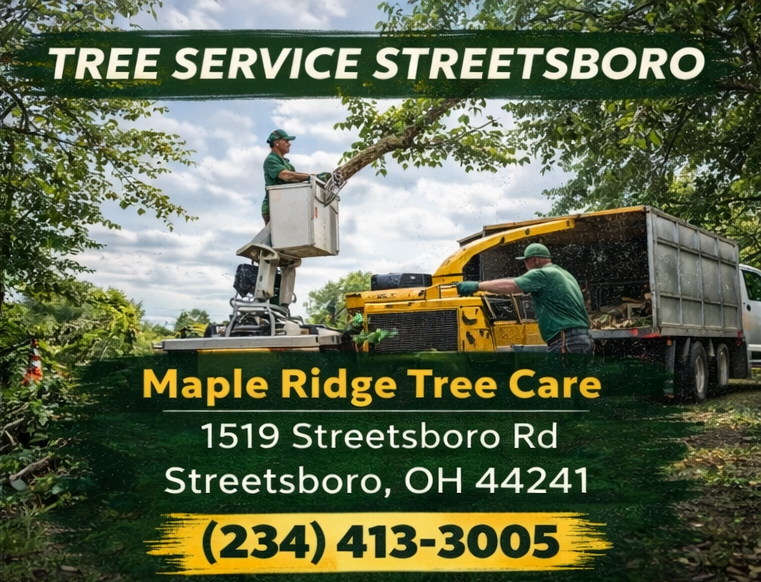
Tree service Maple Ridge Tree Care is one local example of a company that focuses on this kind of transparent approach: site walk‑through, explanation of risks, written scope of work, and follow‑up. Whether you call them or someone else, use that standard as your baseline.
Finally, be wary of prices that are far below the others. Sometimes a lower price just reflects a smaller crew or lower overhead. Other times it means the company is cutting corners on insurance, training, or safety. When you are talking about several thousand pounds of wood suspended over your house, the cheapest option is not always the best value.
Permits, utilities, and neighbors
Most tree removals on private property in Streetsboro do not require a formal permit, but it is always smart to check with the city, especially if the tree is in a front yard near the street. Right of way trees, or trees partly on city property, are treated differently than purely private trees.
Utilities are an absolute must‑address. Before any digging for stump removal, have underground utilities located. Ohio’s “call before you dig” system exists for a reason, and hitting a gas line or buried electric line with a stump grinder is not something you want to experience.
For trees near overhead power lines, do not attempt to work within reach of those lines yourself. In some cases, the utility will handle certain types of clearance work, but for removals, your chosen tree service should coordinate with the utility if needed. Proper timing avoids power disruptions and keeps everyone safer.
As for neighbors, this is where practical experience matters. Shared property line trees cause more disputes than almost any other aspect of tree service. If the trunk crosses the line, both owners typically have a say. Even when the tree is clearly on your side, your neighbor may have strong feelings about losing shade or a privacy screen.
I recommend a straightforward conversation before the work begins. Walk the property line, explain what is planned, show them where branches overhang. In the long run, a 15‑minute chat beats a surprised neighbor watching a tree disappear from their kitchen window.
What to expect on removal day
A professional tree removal generally follows a predictable sequence, even though each property has its own quirks.
The crew will arrive, park in a way that gives them equipment access without blocking your entire street, and walk the site again. They will confirm the tree, plan the drop zone or rigging paths, and identify any fragile areas: septic lids, irrigation heads, old walkways that cannot handle heavy logs.
If there is room and the tree is sound enough, they might perform a straight felling, using ropes, wedges, and careful notching to direct the fall. On most residential Streetsboro lots, especially in denser neighborhoods, removals are done in sections. Climbers or bucket trucks take the tree down piece by piece, lowering branches and trunk sections with ropes to protect lawns, roofs, and fences.
Expect noise. Chainsaws, chippers, and possibly a stump grinder turn a quiet street into a work zone for a few hours. It helps to alert close neighbors ahead of time, especially if you share driveways or parking.
When the main stem is down, the crew will buck the logs to manageable sizes, feed brush into the chipper, and clean up major debris. Good crews rake the work area and leave your yard in reasonably tidy shape. If stump grinding is part of the job, that may happen the same day or on a follow‑up visit, depending on scheduling and soil conditions.
Do not be shy about walking the site with the crew leader at the end. If you wanted certain rounds saved for firewood or chips left for garden use, confirm that before the trucks leave.
Dealing with the stump
People underestimate how much decision making is packed into that remaining chunk of wood at ground level. Treating it thoughtfully can save you frustration later.
Common options for handling stumps include:
- Full stump grinding to below grade, with chips left on site or hauled away Partial grinding for safety and aesthetics, leaving deeper roots in place Leaving the stump intact for habitat, seating, or decorative carving
For most front yards in Streetsboro, full grinding to about 4 to 8 inches below grade is the most practical. You end up with a mound of chips and soil that settles over a few months. Those chips can be spread elsewhere on the property or hauled away if you prefer.
Partial grinding makes sense when roots are entangled with utilities or mature landscaping. In that case, the goal is to remove the tripping hazard and obvious eyesore while minimizing disturbance.
Leaving the stump is more common in backyards or along wooded edges. I have seen homeowners turn old oak stumps into planters, small tables near fire pits, or intentional wildlife habitat. Just remember that an untreated stump will eventually decay and can attract insects or fungi, so placement matters.
Aftercare: what you do once the tree is gone
Tree removal changes the microclimate of your yard overnight. Areas that were shaded become sunny. Wind patterns shift. Soil that stayed evenly moist may start to dry out. If you plan ahead, you can turn that disruption into an upgrade.
Start with the ground where the tree stood. After grinding, let the area settle. You may need to add topsoil to bring it back to grade. If you intend to plant grass, keep in mind that pure wood chips make poor seedbeds. Mix in soil, rake smooth, and seed once the weather cooperates.
Think about replacement planting, but do not rush. Observe how the light falls for a season. Streetsboro backyards often benefit from a smaller, well placed ornamental instead of another giant shade tree planted too close to foundations or driveways. Serviceberries, crabapples, and some smaller maples can give you beauty and moderate shade without overpowering the space.
Where large, removed trees once shaded west facing walls or patios, you may notice heat buildup in summer. That can be offset with pergolas, vines on trellises, or strategically placed new trees that sit far enough from structures to remain safe long term.
If the removed tree was part of a windbreak along a property edge, consider how the gap affects the remaining trees. Sometimes a row of spruces loses one in a storm, and the new edge tree suddenly takes more wind than it ever has. In those cases, proactive tree trimming on the remaining trees can reduce the chance of a domino effect.
Cost realities and seasonal timing
Homeowners often ask, “When is the cheapest time to remove a tree?” The honest answer is: when it is safest and logistically easiest for the crew, which sometimes overlaps with off‑peak demand, but not always.
Frozen ground in winter can actually be an advantage. Heavy equipment leaves fewer ruts on frozen lawns, and leafless canopies make rigging easier on some species. On the other hand, Streetsboro winters bring snow and ice, which can slow work and limit access.
Spring and early summer are busy times for tree service Streetsboro wide, especially after storms. If you can plan non‑urgent removals for late summer or fall, you may have more scheduling flexibility. Do not, however, delay necessary hazard removals just to chase a slightly lower price.
Costs vary with size, difficulty, and risk. A small, easily accessible tree far from structures might be a few hundred dollars. A very large, decayed oak leaning toward a house, with limited access, can run into the thousands. When you compare estimates, pay attention to what is included: debris removal, stump grinding, yard protection measures, and permitting or utility coordination.
From experience, the most expensive removals are almost always the ones delayed for years. A tree that could have been pruned or removed relatively simply becomes a crisis when decay advances or storm damage compounds the problem. Early, honest assessment saves money over the long run.
Red flags and common misconceptions
Several assumptions tend to get homeowners into trouble.
One is, “If it has leaves, it must be healthy.” A tree can leaf out in spring and still be structurally unsound. Decay can hollow out a trunk while the vascular tissue just under the bark continues to function. That is why visual signs of fungus, cracks, and root issues matter more than a quick green‑or‑not glance.
Another misconception is that topping or drastic cutting back will “make the tree safer.” Topping often creates a host of new hazards: weakly attached sprouts, larger wounds that invite decay, and stressed trees that decline faster. Proper structural pruning is a different technique altogether.
Homeowners also sometimes believe that if a tree is on their property, they can do whatever they want with it, branches and roots included. In practice, property line laws, right of way rules, and neighbor rights can complicate this. Before removing a fence line tree or aggressively trimming branches that hang over the line, it is wise to clarify both the legal and relationship aspects.
Finally, watch out for storm chasers. After a big wind event in or near Streetsboro, crews will appear offering same day tree removal for cash. Some are legitimate, many are not. If someone pressures you to sign immediately, refuses to provide proof of insurance, or will not give at least a simple written work order, step back. When a damaged tree is truly urgent, a reputable company can still be transparent and professional.
Bringing it all together
Tree removal sits at the intersection of safety, aesthetics, and long term planning. For Streetsboro property owners, the decision to remove a tree should come from a mix of careful observation, realistic risk assessment, and honest consultation with a qualified tree service.
Use your own eyes first: walk the yard after storms, look for the hazard signs, notice changes over time. When you see something concerning, bring in a professional who can differentiate between a tree that only needs trimming and a tree that genuinely has to come down.
Ask detailed questions. Expect clear explanations. Whether you hire a local provider like tree service Maple Ridge Tree Care or another experienced crew in the area, the right partner will treat your trees as part of a larger landscape, not just as “jobs” to be cut and hauled.
Handled thoughtfully, even the loss of a long standing tree can be the start of an improved, safer, and more resilient yard.